


On this page · 5 sections
Most country closings in central Virginia turn on three things buyers never knew they were buying: a zoning designation, a conservation easement, and a use-value assessment. Get any of them wrong and you can lose half the value of the land — or the right to ever build on it. We walk every client through these before they sign, and the questions are usually the same.

Rural Areas: the 21-acre rule that protects the viewshed
Albemarle County's Rural Areas designation covers the vast majority of land outside the urban growth boundary. The headline rule is the 21-acre minimum lot size — you cannot subdivide a 40-acre parcel into two 20-acre lots. The county's comprehensive plan treats this as core policy, and the development-rights formula (one division right per parcel as of December 1980, plus tightly limited additional rights) is what's kept the country country.
For buyers, this is mostly good news. The pasture across the road from your property cannot suddenly become a subdivision. The catch is that buyers who plan to add a guest house, a manager's cottage, or a parent's cottage need to know exactly how many development rights remain on the deed before they close. We track this on every property we list and every property we represent on the buy side.
Conservation easements: permanent, valuable, and often misread
A conservation easement is a voluntary, recorded restriction held by a qualified organization — the Virginia Outdoors Foundation, the Piedmont Environmental Council, or a local land trust — that permanently limits subdivision and development. Owners keep the land, can farm it, can sell it, can pass it down. They give up the right to break it apart.

The financial side is more generous than people expect. Federal tax law allows the donor to deduct the appraised value of the easement as a charitable contribution. On top of that, Virginia's Land Preservation Tax Credit program provides a state credit equal to 40 percent of the donated value, transferrable to other Virginia taxpayers if the donor cannot use the full amount. On a $4M property with strong development potential, an easement donation can produce credits worth several hundred thousand dollars.
"An easement is the quietest reason Virginia's best country still looks the way it did fifty years ago."
What buyers need to read carefully: the building envelope, the agricultural-use provisions, and any reserved division rights. Two easements on adjacent farms can read very differently. We've seen easements that allow a single 4,000-square-foot dwelling and one ag building, and easements on the same road that allow three additional homesites. Read the document before you fall in love with the land.
Use-value taxation: the line item that pays the easement back
Virginia's land-use taxation program is the second-largest financial mechanism shaping country real estate in the Piedmont. Properties enrolled in agricultural, horticultural, forest, or open-space use are assessed on their use value rather than fair-market value — often a five-to-ten-times reduction in taxable basis. A 40-acre Albemarle farm at $20,000 an acre fair-market might be assessed at $1,500 an acre in use value. The annual tax savings are substantial.
There are obligations: you have to actually use the land. Active hay or grain production, livestock, certified forest management, or qualified open-space programs all qualify. Buyers who plan to take a working farm and stop farming it should price in the rollback tax — five years of the difference between use-value and fair-market assessment, plus interest, payable on the conversion.
Water rights and riparian frontage
Virginia is a riparian-rights state. Owners adjacent to a stream, river, or lake have rights to reasonable use of that water — for livestock, irrigation, household use within limits. Significant withdrawals require permits from the Virginia Department of Environmental Quality. The practical questions on a country property tend to be different: where does the well draw from, what is the flow rate, and how does the spring perform in a dry year.
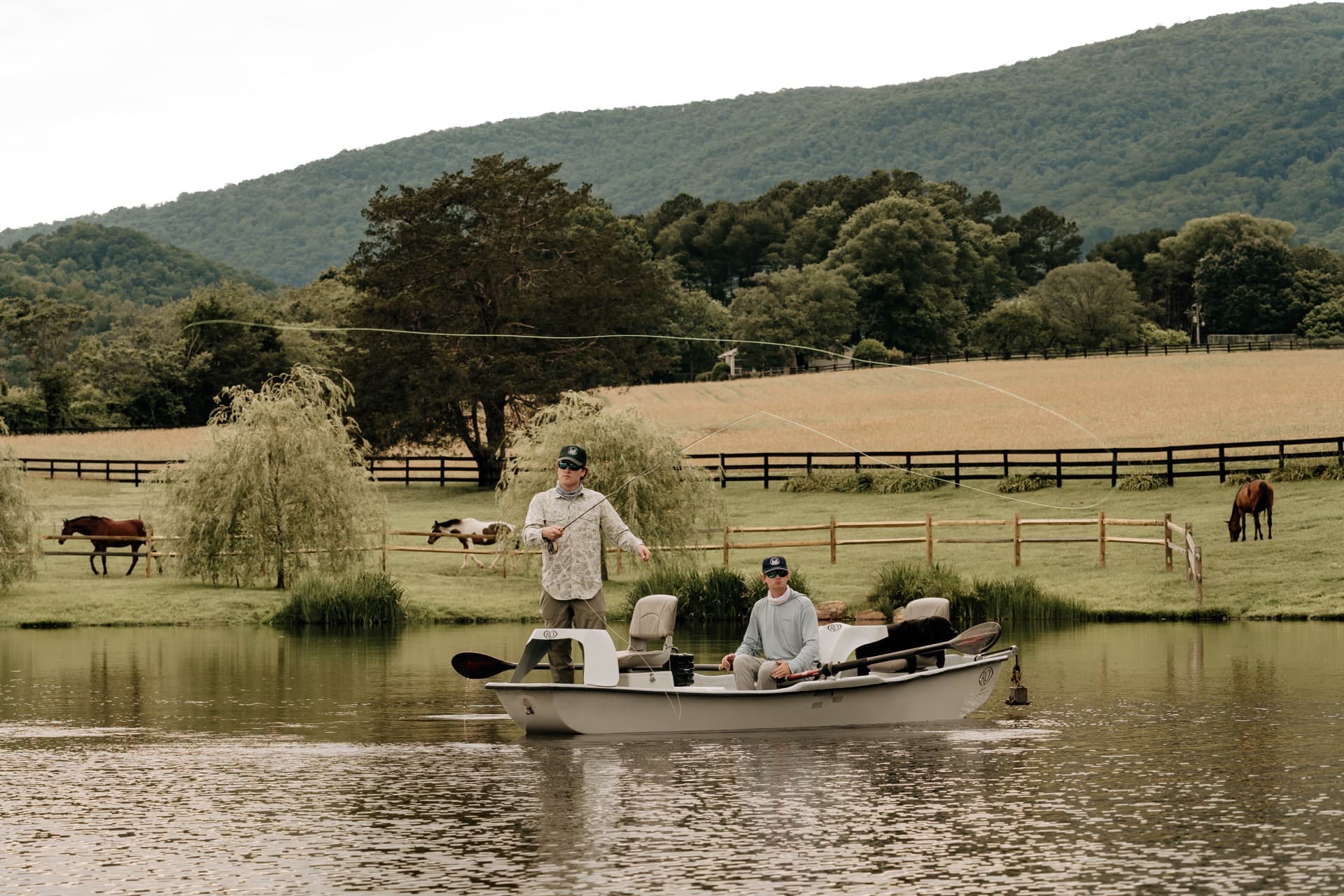
On the lifestyle side, miles of frontage on the Rivanna, the Rapidan, the Moormans, or one of the smaller creeks adds real value, both to the property and to a buyer's life. Fly fishing access alone has talked at least three of our clients into properties they wouldn't otherwise have considered.
What to read before you close
- Recorded conservation easement (every page) — read building envelope, allowed structures, reserved division rights, agricultural use clauses
- Plat showing remaining development rights under Albemarle's RA ordinance
- Land-use taxation enrollment status and rollback exposure
- Title commitment for any reserved easements, rights of way, and shared roads
- VDH well records and septic permit history
- Floodplain mapping for any structures or planned building sites
- If a riparian property: any existing withdrawal permits or shared water agreements
None of this is meant to deter anyone — Virginia's regulatory framework is part of why the country here is still worth what it is. It just rewards buyers who understand the document stack before they sign. We do that work as part of every transaction, and we're happy to explain any of it on a call.
Currently Available
37 PINE DR
$299K